



The severity of the consequences of a conviction represents the primary difference between a wet reckless charge and a charge for driving under the influence (DUI). Typically, wet reckless convictions have less serious penalties than a DUI conviction.
A Los Angeles DUI lawyer can tell you more about the difference between DUI and wet reckless charges.
With their knowledge of California DUI laws and experience navigating the local legal system, lawyers can offer invaluable support throughout every stage of your case.
What are the Differences Between a DUI and a Wet Reckless Charge?
There are several legal differences between DUI and wet reckless allegations. These differences focus on:
How You Can Face a Charge
Drivers can face DUI charges if the police accuse them of operating a vehicle while impaired by alcohol. Generally, drivers only face this charge after an arrest.
“Wet reckless,” however, is a charge of reckless driving only faced by motorists accused of driving drunk as part of a plea bargain. The police cannot arrest you for wet reckless; the only way to face this charge is for the police to arrest you for a DUI and for the prosecution to downgrade your charge.
The Definition of the Charges
Drivers can face charges under CA Vehicle Code 23152 (a) – Driving Under the Influence of Alcohol if the police accuse them of driving while impaired by alcohol. In many cases, the police use this charge to arrest individuals with a blood alcohol content (BAC) level of 0.08% or above.
However, drivers can face DUI charges any time the police accuse them of impairment, regardless of their precise blood alcohol concentration level.
CA Vehicle Code 23103.5 – Wet Reckless Driving charges, on the other hand, require a driver to admit to engaging in reckless behavior behind the wheel while under the influence of alcohol (or drugs). You can learn more about the difference between a DUI and wet reckless charge from your criminal defense attorney.
What’s the Difference Between Reckless Driving and Wet Reckless Charges?
Reckless driving refers to driving in a way that potentially endangers others. For example, speeding, running up onto the sidewalk, or swerving out into oncoming traffic. This charge is serious because it threatens people’s lives. Drivers can face reckless driving allegations without drinking alcohol.
“Wet” reckless charges are explicitly used as a plea bargain option after an arrest for drunk driving.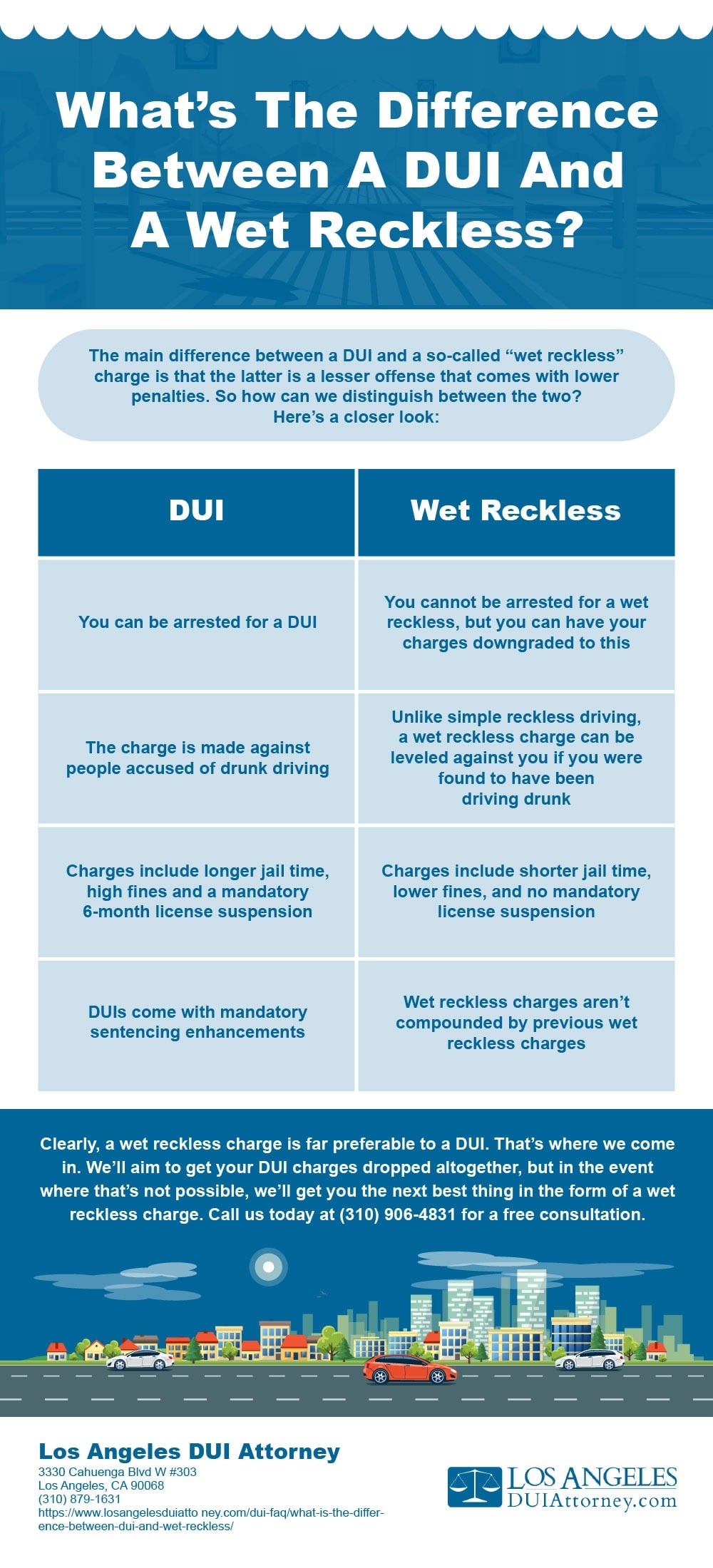
Advantages of a Wet Reckless Charge
While every case is unique and outcomes vary, understanding the potential advantages of a VC 23103.5 plea bargain can be crucial for individuals navigating the legal process. An experienced DUI attorney in Los Angeles will help you maximize the benefits of this type of charge.
The advantages of a plea bargain may include:
Shorter Jail Time
The sentence for even a first-time DUI can be up to six months in jail. Repeat DUIs can be up to a year. But the maximum jail sentence for wet reckless driving is 90 days, and often, the real sentence is far less.
Lower Fines
A VC 23103.5 plea bargain isn’t cheap; the maximum fine is $1,000. But that’s nothing compared to a DUI. When you add in court “assessments,” even the minimum fine for a first-time DUI is nearly twice that, and a DUI can easily cost $3,000 or more. Reckless is cheaper.
No Mandatory License Suspension
Wet reckless does not carry any form of license suspension, although you still need to fight your administrative suspension in a DMV hearing. A DUI, on the other hand, carries a mandatory 6-month suspension for even a first-time offense and a year or more for subsequent offenses.
Wet reckless also has other advantages, such as shorter (if any) DUI school and shorter probation.
Additionally, if you have a prior DUI on your driving and criminal record and get a new DUI conviction today, the sentence will be much worse the second time than it was the first time around. However, if that second DUI charge gets dropped to a wet reckless, there is no extra penalty. The wet reckless penalties are the same, even for repeat offenders.
Disadvantages of a Wet Reckless Charge
While a wet reckless charge may offer certain advantages compared to a standard DUI conviction, it’s essential to consider the potential drawbacks associated with this alternative charge. Understanding the disadvantages of a wet reckless charge will help you weigh your legal options and make informed decisions about your case.
Possible drawbacks of a wet reckless charge include:
- If you’re arrested for DUI again in the future, the wet reckless will still count as a prior DUI for purposes of sentencing.
- The California Department of Motor Vehicles (DMV) will still automatically suspend your license for a DUI, and you still need to fight this suspension by requesting an administrative per se hearing within 10 days of your arrest.
- Your insurance company will likely increase your rates in the same way they would for a DUI.
Additionally, you may face a requirement to install an ignition interlock device (IID) on your vehicle as part of your plea agreement in some situations.
Getting Your Charge Downgraded
A wet reckless conviction is clearly not an ideal solution. Any good DUI attorney in Los Angeles will aim for one thing: to get your charges dismissed or to win your case. However, in situations where that’s unlikely, a wet reckless conviction is a promising option.
Prosecutors don’t give out free passes, however. They will not offer to downgrade the charge against you unless they have to. Normally, that means a DUI lawyer works on your case and finds a way to pressure them.
If your lawyer can discredit the breath test evidence against you as part of your DUI defense, for example, the prosecution’s case just got harder. They don’t want to risk losing altogether and have an incentive to offer you a deal through plea negotiation.
Important Statistics About Drunk Driving Arrests
The California DMV’s report on DUI arrests by county reveals notable figures for Los Angeles County (LAC). In 2018, LAC saw 24,642 DUI arrests, followed by 23,529 in 2019 and 17,780 in 2020, indicating a declining trend in DUI incidents. This trend hints at potential shifts in factors such as law enforcement strategies or changes in DUI behavior patterns.
Additionally, the Annual Report of the California DUI Management Information System provides insight into the types of DUI arrests in 2020. Of the total arrests, 852 were classified as felony DUIs, 35 as juvenile DUIs, and 16,893 as misdemeanor DUIs.
This breakdown underscores that the majority of DUI arrests in 2020 were for misdemeanor offenses.
Learn More About Wet Reckless Deals
So, what is the difference between a DUI and a wet reckless? DUI charges are direct, serious criminal allegations, while prosecutors use wet reckless charges as part of plea bargains that can reduce the severity of a DUI.
If you’ve been charged with DUI, you need to act fast. The sooner you get a lawyer, the more they can do to help your case. Time is of the essence in DUI cases, as crucial evidence may be time-sensitive, and you can face legal deadlines.
By securing legal representation promptly, you allow your attorney to thoroughly review the details of your arrest, gather evidence, and develop a strong defense strategy. We’re happy to match you with an experienced Los Angeles DUI lawyer who will give you a free, detailed consultation. Contact us to get your free consultation today.
 Fact Checked